4-Week At-Home Workout Plan: Daily Training + Stretching
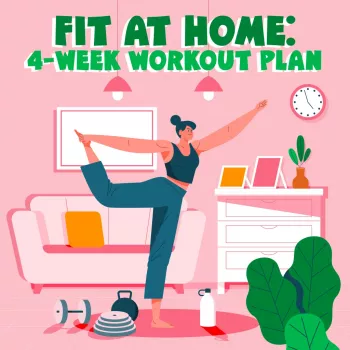
Fit at Home: A Simple 4-Week Plan With Daily Workouts and Stretches (Minimal Equipment)
A structured month of at-home training can make consistency easier than improvising each day. This guide lays out a clear 4-week routine using minimal equipment, with daily workout themes, simple progression, and built-in stretching so recovery stays part of the plan—not an afterthought.
Who This 4-Week At-Home Plan Fits Best
- Beginners who want clear daily direction and repeatable movement patterns
- Busy schedules needing efficient sessions that can scale from 15–45 minutes
- Anyone training in small spaces with limited gear (bodyweight plus a few optional items)
- People who want both workouts and stretches organized day by day
- Those returning to fitness and needing gradual progression across weeks
Minimal Equipment Setup (And Smart Substitutions)
Keep your setup simple so the plan is easy to repeat. The goal is to remove friction: fewer decisions, more consistent training.
- Core setup: a stable chair/bench, a mat or towel, and a timer (phone works)
- Optional upgrades: resistance band loop, light-to-moderate dumbbells, jump rope
- Substitutions: backpack with books for load; water jugs for dumbbells; towel sliders on a smooth floor
- Space check: aim for a 6×6 ft area, plus a wall for balance and stretching
- Safety basics: non-slip surface, clear floor, and controlled tempo before adding speed
Equipment Options and At-Home Alternatives
| Training need | Simple option | Alternative if unavailable |
|---|---|---|
| Added resistance | Dumbbells | Backpack loaded with books |
| Pulling / upper back | Resistance band | Towel isometrics (row against a sturdy post) |
| Cardio finisher | Jump rope | Marching high knees or step-ups |
| Core + stability | Exercise mat | Folded towel or carpeted area |
| Mobility support | Yoga block | Thick book or firm pillow |
How the 4 Weeks Progress (Without Overcomplicating It)
- Week 1: learn form, choose a sustainable pace, and leave 1–3 reps in reserve on most sets
- Week 2: add a small dose—one extra set, a few reps, or slightly longer work intervals
- Week 3: build density—shorter rest, smoother transitions, or one extra round in circuits
- Week 4: consolidate—repeat best sessions, push effort on key sets, and prioritize recovery
- Progression rule of thumb: change only one variable at a time (reps, sets, load, or rest)
This approach aligns with established progression models for resistance training—small, repeatable upgrades tend to beat random max-effort days. For deeper background, see the ACSM position stand on progression models.
Weekly Schedule Template (Repeatable Daily Structure)
- Day 1: Lower body strength + mobility (squat/hinge focus)
- Day 2: Upper body strength + posture (push/pull balance with minimal equipment)
- Day 3: Low-impact cardio + core stability (zone 2 feel or intervals based on fitness level)
- Day 4: Full-body circuit (short, efficient, sweat-focused)
- Day 5: Glutes/legs + core (unilateral work, balance, and bracing)
- Day 6: Mobility and stretching session (hips, shoulders, spine; breathing-led)
- Day 7: Rest or gentle walk (recovery as a scheduled training input)
For weekly targets, the Physical Activity Guidelines for Americans and the CDC activity recommendations both support a mix of strength work plus aerobic movement across the week.
Daily Session Blueprint (15–45 Minutes)
- Warm-up (5–8 minutes): joint circles, easy marching, hip hinge patterning, shoulder openers
- Main work (10–30 minutes): 2–5 exercises, organized as sets or a simple circuit
- Finisher (optional, 3–8 minutes): low-impact intervals (step-ups, fast walks, shadow boxing)
- Cool-down stretching (5–10 minutes): calves, hip flexors, hamstrings, chest, upper back
- Effort guide: most days should feel challenging but controllable; save all-out effort for 1–2 sessions per week
Key Exercise Menu (Choose Based on Space and Equipment)
Lower Body
- Bodyweight squat
- Split squat
- Glute bridge/hip thrust (shoulders on floor or bench)
- Romanian deadlift (with a backpack hugged to chest or held by straps)
- Calf raises (two-leg, then single-leg as you improve)
Upper Body (Push + Pull)
- Incline push-up (hands on chair) progressing to floor push-ups
- Overhead press (light weights/band) or pike push-up variation
- Band rows or towel isometric rows for upper-back strength
- Band pull-aparts or prone Y-T-W raises to reinforce posture
- Suitcase carries (one-sided load) for trunk stability and grip
Core + Cardio Options
- Dead bug, bird dog, plank variations, side plank
- Brisk walk, step-ups, low-impact jumping jacks, mountain climbers (slow to fast)
Stretching and Mobility Focus (Daily, Not Only on Rest Days)
- Hips: hip flexor stretch, figure-4 stretch, adductor rock-backs
- Posterior chain: hamstring stretch (strap/towel), calf stretch against wall
- Shoulders/chest: doorway pec stretch, thread-the-needle, wall slides
- Spine: cat-cow, open book rotations, child’s pose breathing
- Simple pacing: 20–40 seconds per stretch, 1–2 rounds; aim for gentle intensity, no sharp pain
How to Adjust the Plan for Different Fitness Levels
Common Mistakes That Stall Progress at Home
Printable 4-Week Guide Option (Daily Workouts + Stretches)
- Fit at Home: 4-Week Workout Plan (PDF) with Daily Workouts & Stretches
- Fuel Your Life: Healthy Eating Starter Bundle
FAQ
How long should each daily workout take in a 4-week at-home plan?
Plan for 15–45 minutes: about 5–8 minutes to warm up, 10–30 minutes for the main work, and 5–10 minutes to cool down and stretch. To scale down, reduce the number of sets or circuit rounds while keeping the warm-up and a short cool-down.
Can results happen with minimal equipment and bodyweight only?
Yes—results come from progressive overload and consistency, not fancy gear. Increase reps, add a set, slow the tempo, shorten rest, or use a loaded backpack to make familiar movements more challenging over time.
What should a daily stretching routine include after home workouts?
Include hips, hamstrings, calves, chest/shoulders, and gentle spinal mobility (cat-cow or rotations). Hold most stretches 20–40 seconds for 1–2 rounds at a mild-to-moderate intensity—strong tension is fine, sharp pain isn’t.















Leave a comment