Meaningful Conversation Starters for Dating, Friends & Work
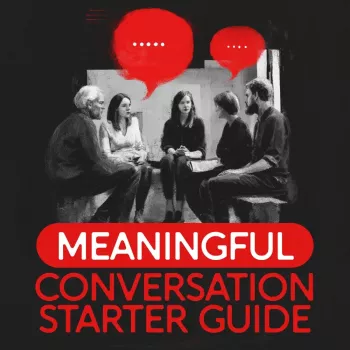
Meaningful Conversation Starter Guide for Dating, Friendship, and Networking
Good conversations rarely happen by accident—they’re shaped by tone, timing, and the right kind of question. This printable guide is designed to help conversations move from polite small talk into genuine connection without feeling scripted, whether the setting is a first date, a new friendship, or a professional event.
What makes a conversation feel meaningful
“Meaningful” usually doesn’t mean “deep right away.” It means the other person feels safe, seen, and invited to be real—at a pace that fits the moment.
- Psychological safety first: Warm body language, a steady pace, and non-judgmental reactions make it easier for someone to open up. Even small signals—nodding, relaxed shoulders, and letting them finish—change the entire tone.
- Specificity beats generality: “How was your day?” can be answered in one word. “What was the best part of your day?” points to an actual experience and usually gets a story.
- Balanced sharing: A brief personal detail after you ask a question keeps it mutual rather than interview-like. Think: ask, listen, respond, then add a short related example from your own life.
- Emotional range: Mix light, reflective, and future-oriented topics. A conversation that stays serious can feel heavy; a conversation that stays light can feel forgettable.
One practical skill that makes nearly any question work better is active listening—reflecting what you heard and asking a simple follow-up. Helpful research-backed guidance is available from Greater Good Magazine (UC Berkeley) on active listening and relationship resources from the American Psychological Association.
How to use the printable guide in real life
The fastest way to sound natural is to prepare lightly—then stay present. Instead of scrolling for the “perfect” question mid-conversation, choose a short set ahead of time.
- Pick 6–10 questions before the interaction so choices don’t interrupt flow.
- Start low-stakes, then step deeper once rapport is clear.
- Use follow-ups like: “What made that stand out?” “How did that change you?” “What happened next?”
- Watch cues: Green lights include longer answers and curious questions back. Yellow lights include short replies or repeated topic changes.
Quick flow for natural conversation
| Phase | Goal | What to say/do | When to move on |
|---|---|---|---|
| Warm-up (2–5 min) | Ease and comfort | Ask an easy, present-moment question and mirror their energy | They begin asking you questions or expand their answers |
| Bridge (5–10 min) | Find shared ground | Choose a values- or story-based question tied to something they mentioned | You both share at least one personal example |
| Deepening (10+ min) | Build connection | Use 1–2 reflective questions with gentle follow-ups | If the mood shifts to heavy/tense, lighten or change topics |
| Close | Leave it positive | End with appreciation and a forward-looking note | Time is up or energy naturally dips |
Conversation starters for dating that feel confident, not intense
Dating questions work best when they invite personality and keep pressure low. The goal isn’t to “skip steps”—it’s to create enough comfort for real stories to show up.
- Openers that invite personality: Ask about a recent small joy, a favorite local spot, or a habit they’re proud of.
- Values without pressure: Explore what “a good weekend” looks like for them or what they’re learning lately.
- Chemistry through stories: Invite a travel mishap, a funny fail, or a moment they felt brave.
- Gentle depth: “What’s something you want more of in your life this year?”
If you want a ready-to-print set you can circle and bring along (or keep on your phone for quick prep), see the Meaningful Conversation Starter Guide (Printable).
Conversation starters for building friendship faster
Friendship builds through repeated “small proofs” of compatibility: shared humor, similar rhythms, and feeling understood. Questions should be easy to answer but specific enough to spark follow-up.
Conversation starters for networking without the awkwardness
For more general communication advice in professional settings, browse resources from Harvard Business Review.
Question bank by setting
| Setting | Warm-up question | Deeper question | Easy close |
|---|---|---|---|
| Dating | What’s been a highlight of your week so far? | What’s a belief you’ve changed your mind about? | What would make next week feel like a win? |
| Friendship | What do you like doing when you have a free evening? | What’s something you’re working on personally? | Want to swap recommendations for places to try? |
| Networking | What are you focused on this quarter? | What’s a lesson you learned the hard way in your work? | Is there a link or resource you’d like me to send you? |
Deep questions that don’t feel like an interrogation
Common stalls and simple recoveries
Printable guide highlights and when it helps most
Pairing conversation practice with confidence-building routines can also help you show up more grounded. If mindset support is part of your routine, consider Daily Affirmations for Abundant Wealth (Audio Course) for an easy daily listening habit.
FAQ
How many questions should be asked in one conversation?
Aim for 3–6 core questions with natural follow-ups. A warm-up, a bridge question, and one deeper question is usually plenty when the flow is mutual and you’re both sharing.
What if a deep question makes things uncomfortable?
Acknowledge it briefly, give an easy out (“No pressure to answer”), and pivot to something lighter or more concrete. Asking permission for depth and reading cues keeps the conversation respectful.
Can this be used for both dating and professional networking?
Yes—the same structure works across settings when you adjust intensity and topics. In professional contexts, “deeper” questions can stay work-safe by focusing on lessons learned, values at work, and goals.













Leave a comment