Roth vs. Traditional IRA: A Beginner’s Decision Checklist

Choosing between a Roth IRA and a traditional IRA does not require you to predict your entire financial future. Start with a narrower question: would a potential tax benefit help you more now or later? Our beginner’s checklist helps you compare the accounts, identify rules to verify, and write down a next step you can revisit as life changes.
Start with the tax difference
With a traditional IRA, an eligible contribution may be deductible, potentially reducing your taxable income for the year. Withdrawals are generally taxable. Roth IRA contributions use after-tax money, but qualified withdrawals are generally tax-free. That contrast is useful, though it is not the whole decision: a traditional IRA deduction is not automatic, and your ability to contribute directly to a Roth IRA can depend on your income.
| Question | Roth IRA | Traditional IRA |
|---|---|---|
| When is the potential tax advantage? | Generally on qualified withdrawals | Potentially when an eligible contribution is deducted |
| Are direct contributions subject to income limits? | Yes | No, but deductibility may be limited |
| Are lifetime required minimum distributions generally required for the original owner? | No | Yes |
Use this comparison as a starting point, not as a substitute for current rules. Your filing status, income, and coverage under a workplace retirement plan can affect the answer. The IRS overview of traditional and Roth IRAs is a useful place to verify how each account works.
Work through a five-question decision checklist
1. Would a deduction help you this year?
If a current deduction would meaningfully improve your tax situation, investigate whether you qualify for one through a traditional IRA. Do not assume that having a traditional IRA makes every contribution deductible. In particular, workplace-plan coverage and income can limit deductibility.
2. How do you weigh taxes now against taxes later?
If you expect a higher tax rate when you withdraw the money, Roth treatment may be appealing. If a deduction is especially valuable today, a traditional IRA may deserve a closer look. Future tax rates—and your future income—are uncertain, so treat your expectation as one factor rather than a promise about the outcome.
3. Can you contribute directly to a Roth IRA?
Check the income thresholds for the tax year of your contribution and your filing status. Figures can change, and last year’s eligibility does not settle this year’s question. If you cannot contribute directly, avoid treating a different strategy as an automatic workaround; additional rules may apply.
4. When might you need the money?
IRAs are designed for retirement savings. Early withdrawals can trigger taxes or penalties, depending on the account, the money withdrawn, and your circumstances. Before committing money you may need soon, consider whether your emergency fund and other near-term savings goals are covered.
5. Would both tax treatments be useful?
You do not necessarily have to choose only one type of IRA forever. Holding both may give you flexibility in retirement, provided you are eligible to contribute. Remember that contributions across your Roth and traditional IRAs share one annual IRA contribution limit; opening two accounts does not double it.
Turn your answers into an action plan
Write down your filing status, approximate income, whether you or your spouse has workplace retirement-plan coverage, and which potential benefit matters more to you right now: a current deduction or qualified tax-free withdrawals later. Add any uncertainty you need to resolve. A short written record is more useful than trying to keep changing rules and assumptions in your head.
Next, confirm the applicable tax year’s contribution limit, eligibility rules, and deadline. The IRS IRA contribution limits page provides a starting point. If your taxes involve complications such as uncertain deductibility or multiple sources of income, consider speaking with a qualified tax professional before contributing.
Keep the account choice separate from the investment choice. Choosing a Roth or traditional IRA determines tax treatment; choosing an IRA provider and investments determines where the account is held and how its money is invested. Opening an account does not, by itself, select investments. You will still need to consider your time horizon, tolerance for risk, and investment costs.
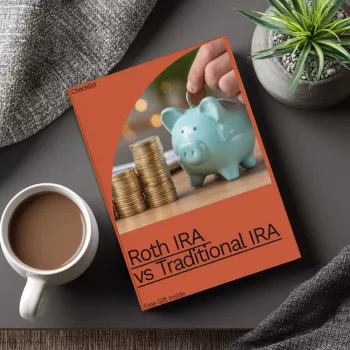
Our printable Roth IRA vs. Traditional IRA Checklist gives you one place to organize your answers and follow-up questions. Use it as a planning aid, not personalized tax advice. If turning that decision into a regular review habit is the harder part, our Ultimate Productivity Blueprint is a separate guide for setting goals and building routines; it does not replace IRA or investment guidance.
Revisit the choice when life changes
An IRA decision is worth reviewing after a substantial income change, a new workplace retirement plan, or a change in filing status. Those events can affect eligibility, deductibility, or the relative value of the tax treatments. A short-term market move, on its own, is a less useful reason to change your account approach. Return to your checklist, update the facts, and verify the rules for the year in which you plan to contribute.
FAQ
Can I contribute to both a Roth IRA and a traditional IRA?
Yes, if you are eligible. Contributions to both accounts count toward the combined annual IRA contribution limit.
Is a Roth IRA always better for beginners?
No. Your eligibility, the value of a possible current deduction, and your expectations about future taxes all matter. Neither account is universally better.
Does an IRA checklist tell me which investments to buy?
No. A checklist can organize your account-type decision, but investment choices require separate consideration of your time horizon, risk tolerance, and costs.















Leave a comment